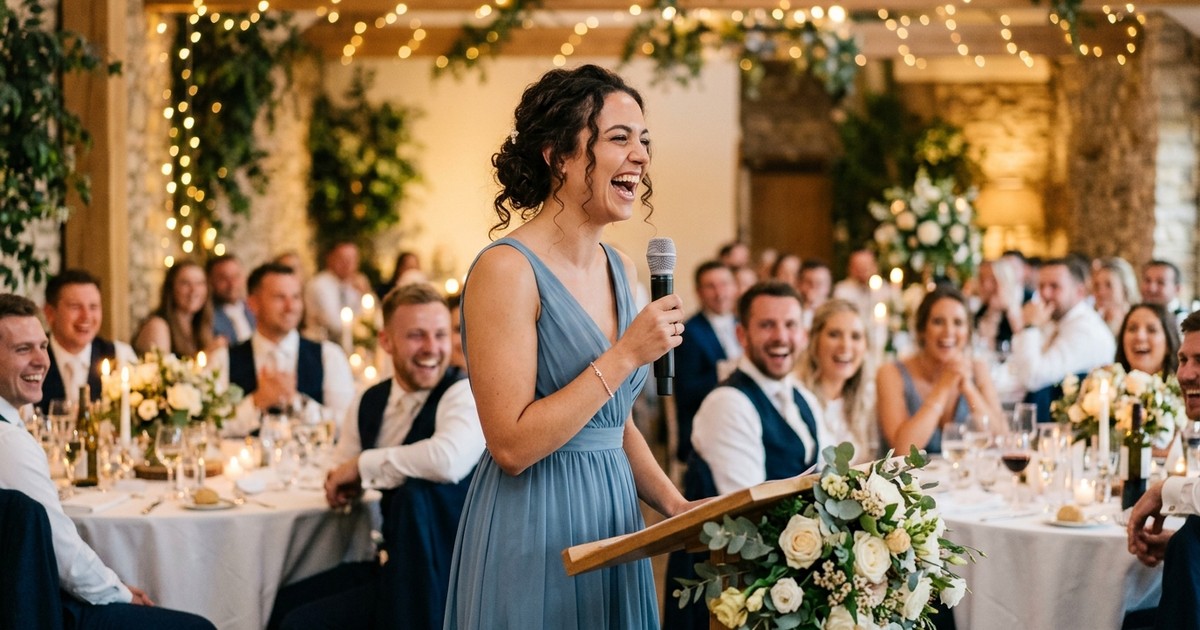
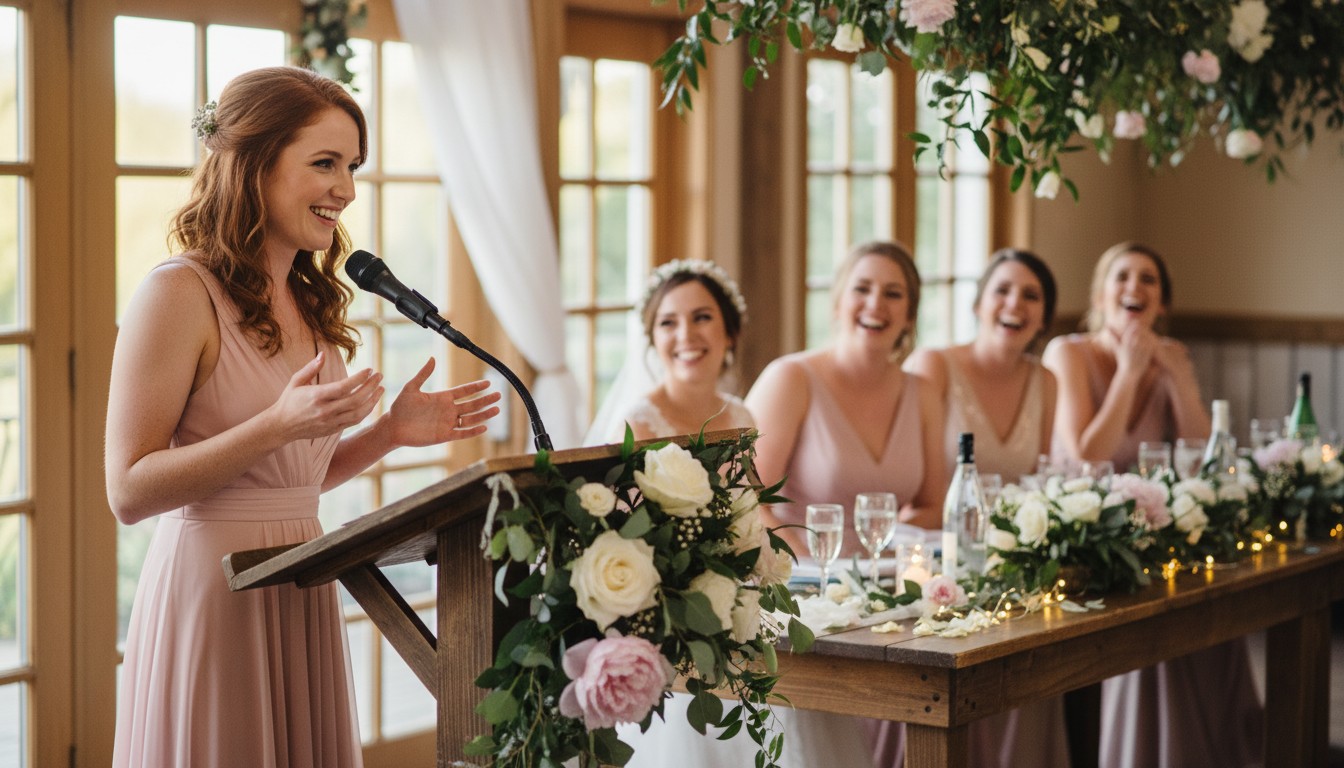
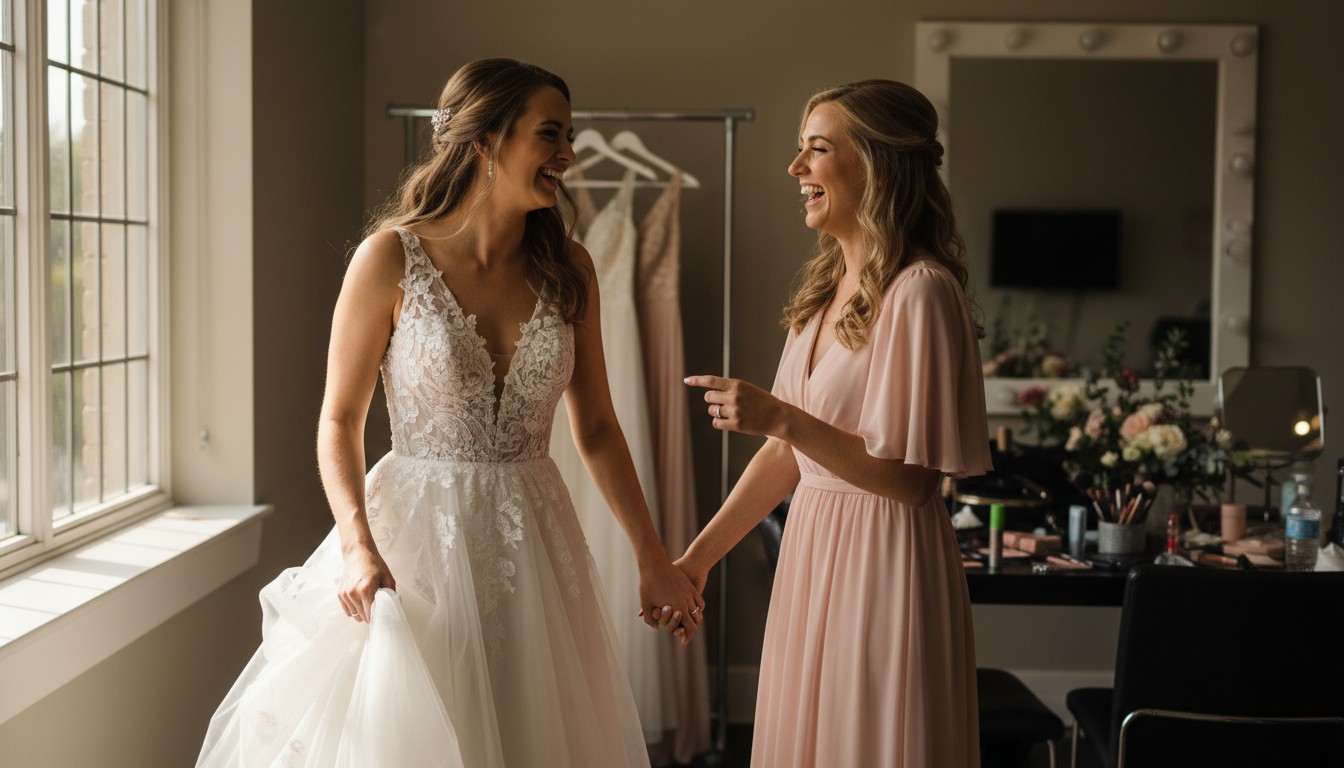
How to Write a Maid of Honor Speech for Your Sister
Writing a maid of honor speech for your sister is harder than it sounds. You know too much, feel too much, and have too many stories. Here is how to pick the right one and say what she needs to hear.
Part of the Maid of Honor Speech Guide : everything you need to write a speech your best friend (or sister) will quote for years.
Writing a maid of honor speech for your sister is a specific kind of hard. It is not the "I have nothing to say" kind of hard. It is the opposite. You have twenty-five years of material, a hundred stories that would work, and the certain knowledge that if you pick the wrong one, she will bring it up every Thanksgiving for the rest of your life. You know her better than anyone in that room, which means you also know which stories will make her cry, which ones will make your mother cry, and which ones absolutely cannot be told in front of the groom's family.
The challenge is not finding something to say. It is choosing the one thing that says everything. The one story, the one moment, the one observation that captures who she is and what she means to you, without turning it into a twenty-minute monologue that empties the dance floor.
This guide is specifically for sisters. Not best friends. Not sorority sisters. Not work wives. Sisters. Because the sister dynamic is different from every other relationship in the room. The history is longer, the material is deeper, the emotional stakes are higher, and the audience is already expecting you to cry by the second sentence. The playbook for a best friend speech does not quite apply here. You need a different one.
Why a sister speech is different from a best friend speech
You did not choose each other. That is the first and most important difference. A best friend speech is built on the story of choosing someone. A sister speech is built on something stranger and more interesting: you were assigned to each other, and you figured out how to love each other anyway. That is its own kind of story, and it is one the room wants to hear.
You have childhood material that no friend has access to. The shared bedroom. The fights over who got the front seat. The phase where she refused to talk to you for an entire summer. The moment, years later, when she called you at midnight because something happened and you were the only person she wanted to tell. A best friend has the highlight reel. You have the whole film, including the parts nobody else was in the room for.
The audience expects more emotion from a sister than from a friend. That is just the reality of the role. When a best friend tears up during a speech, it is touching. When a sister tears up, it hits differently, because everyone in the room can feel the weight of a shared life behind it. Lean into that. But earn it with specifics, not sentimentality. A vague "she means the world to me" does not land the way a precise memory does.
You also have family context that nobody else can bring. You know what your parents sacrificed. You know what she went through in high school. You know the version of her that existed before the version standing up there in white. You saw her at fifteen, confused and stubborn and figuring it out. You saw her at twenty-two, finally becoming the person she was always going to be. That depth is your advantage over every other speaker at that reception. Use it.
The structure that works for sister speeches
Most sister speeches that land well follow a four-part structure. It is not a rigid template. Think of it as a spine that keeps you from wandering into a fifteen-minute tangent about summer camp.
1. The shift (30 to 45 seconds)
When did she go from your annoying little sister, or your bossy older sister, to someone you genuinely admire? That transition is the emotional core of the speech. Name the moment. It does not have to be dramatic. It can be the time she showed up at your apartment with soup when you were sick and did not even ask if you wanted company. It can be the way she handled something difficult without telling anyone until it was over. The shift from "my sister" to "my person" is the most powerful beat you have. Put it at the top.
2. One story that proves it (60 to 90 seconds)
Not a list of qualities. Not "she is kind, she is strong, she is funny." One specific memory that shows the room who she is without you having to explain it. The more concrete the details, the better. What was she wearing. What did she say, word for word. What did the room look like. Specificity is what separates a speech that people remember from a speech that sounds like a greeting card.
If you find yourself saying "she always" or "she is the type of person who," you have gone too general. Zoom back in. One moment. One story. Let it do the work.
3. What you see now (30 seconds)
This is where the groom enters the speech. Not with a list of his qualities or a joke about how he better treat her right. Instead, share something you have observed about who she is when she is with him. Something the rest of the room might not notice. The way she laughs differently around him. The way she stopped second-guessing herself after they got together. The way she says his name. These small observations carry more weight than any declaration about how perfect they are together, because they show the room that you have been paying attention.
4. The toast (15 to 20 seconds)
Short. Direct. From the heart. Do not try to be clever here. Do not end with a quote you found on the internet. Look at her and say the thing. "I am so proud of who you are." "I could not love you more." "To my sister and the person who made her this happy." Then raise your glass and sit down. The best endings feel like they arrive exactly when they should.
Five sister maid of honor speech examples
These are excerpts, not full speeches. Each one demonstrates a different angle on the sister dynamic. Use them as starting points, not scripts.
1. The protective older sister
"When Natalie was born, I was four years old and deeply unimpressed. I had asked for a puppy. Instead, I got a roommate who cried all night and could not even play catch. But somewhere around the time she was seven and I was eleven, something changed. She stopped being my little sister and started being my favorite person. I remember the exact day. She had lost a spelling bee at school and came home furious. Not sad. Furious. She sat at the kitchen table and made flashcards for three hours. She was seven. I looked at her and thought, oh. She is going to be fine. She is going to be more than fine. And I was right. Natalie, I have spent most of my life feeling like it was my job to protect you. Standing here today, watching who you have become, I think you might have been protecting me all along."
Why it works: The speech names a specific moment when admiration replaced obligation. The spelling bee detail is concrete and visual. The final reversal, from protecting to being protected, earns its emotion because the story set it up.
2. The younger sister looking up
"I spent most of my childhood following Rachel around and pretending I was not following her around. She went to soccer practice, I went to soccer practice. She started reading mystery novels, I started reading mystery novels. She cut her hair short junior year, and I would have cut mine too, except Mom intervened. I wanted to be her so badly that I forgot to figure out who I was for a while. But here is the thing about having a sister you admire that much: she never let me disappear into her shadow. She would look at me and say, 'Em, that is my thing. Go find your thing.' It took me a while. But I found it. And I found it because she told me to go look. Rachel, I do not want to be you anymore. But I still want to be next to you for every big moment. Starting with this one."
Why it works: It builds on a universal sister dynamic, the younger one imitating the older one, but flips it into a story about identity. The direct quote gives it texture. The closing line is warm without being sentimental.
3. The sisters who fought
"If you have known Lauren and me for any length of time, you know that we were not always standing side by side like this. We fought. Loudly, frequently, and about things that mattered to absolutely no one. Who borrowed whose jacket. Who told Mom about the dent in the car. Who was the favorite. We went through two years in high school where we barely spoke, and another year in college where we only spoke to argue. I am not going to pretend that was a phase or that it did not matter. It did. But at some point, I do not remember exactly when, we stopped fighting about small things and started calling each other about big things. She called me after her first real heartbreak. I called her when I almost dropped out of school. And somewhere in those phone calls, we stopped being opponents and started being partners. Lauren, I would not trade the fights. They are part of how we got here. To my sister, who I finally like as much as I love."
Why it works: The honesty is what makes it land. By not pretending the relationship was always easy, the speaker earns the sincerity of the ending. The transition from "opponents to partners" gives the speech a clear arc without forcing sentimentality.
4. The shared childhood memory
"Every Sunday morning growing up, our dad made pancakes. Not good pancakes. Objectively bad pancakes. Burnt on the outside, raw in the middle, and served with a level of pride that made it impossible to say anything. Jess and I would sit across from each other at the kitchen table and communicate entirely through eye contact. One look that said, 'these are terrible.' Another look that said, 'I know, just eat them.' A tiny shake of the head that said, 'do not laugh.' We spent ten years eating those pancakes and never once broke. That kitchen table is where I learned that Jess and I could survive anything, as long as we could look at each other and know what the other one was thinking. I still know what she is thinking. And right now, she is thinking, 'please do not make me cry before dinner.' Too late, Jess. To my sister."
Why it works: One small recurring memory becomes the vehicle for something much bigger. The pancake detail is specific enough that it feels real and funny. The callback to eye contact at the end ties the speech together without forcing a conclusion.
5. The sister who lives far away
"Maya and I have lived in different cities for six years now. Before that, we lived in different dorms, different apartments, different time zones. We have not shared a roof since we were seventeen. People ask me if that is hard, and I always say no, because it sounds dramatic to say yes. But it is. It is hard. I miss her constantly. Not in the way you miss someone who is gone, but in the way you miss someone who is right there, just not close enough to sit next to on a Tuesday. We talk every week. Sometimes every day. We send each other photos of things that do not matter, restaurant menus and weird birds and shoes we will never buy, because the photos are not the point. The point is saying, I saw this and thought of you. I am still thinking of you. Maya, today is the first time in a long time that we are in the same room for more than a weekend. And I am not going to waste it. I love you. I am so proud of you. To my sister and the person who finally convinced her to stay in one place."
Why it works: The speech does not avoid the distance; it makes the distance the subject. The detail about sending pointless photos is the kind of specific observation that makes a room go quiet. The final joke about staying in one place releases the tension perfectly.
The stories to avoid
Not every sister story belongs in a wedding speech. Some of your best material is best material precisely because it is private. Here is what to leave out.
Childhood embarrassments she did not approve for public consumption. If you are not sure whether she would be okay with a story, ask her. Do not surprise her with the time she wet the bed at a sleepover in fifth grade. That is not a gift. That is an ambush.
Family drama, divorces, or difficult periods. Unless she specifically asked you to reference them, leave the hard years alone. The audience does not need to know about the rough patch your parents went through, or the year she barely came home. This is not the venue for processing family history.
Stories that are really about you. It is easy to disguise a speech about your own feelings as a speech about your sister. Watch out for the version where the real message is "I am scared of losing you" or "things will never be the same." This day is not about what you are losing. It is about what she is gaining. If your speech has more sentences starting with "I" than sentences about her, rewrite it.
Anything that positions the groom as "taking her away." The groom is not a villain in a heist movie. He did not steal your sister. She chose to build a life with someone, and your job today is to celebrate that, not to frame it as a loss. Save the "you better take care of her" speech for a private conversation. In front of two hundred people, it sounds possessive, not protective.
How to get through it without losing it
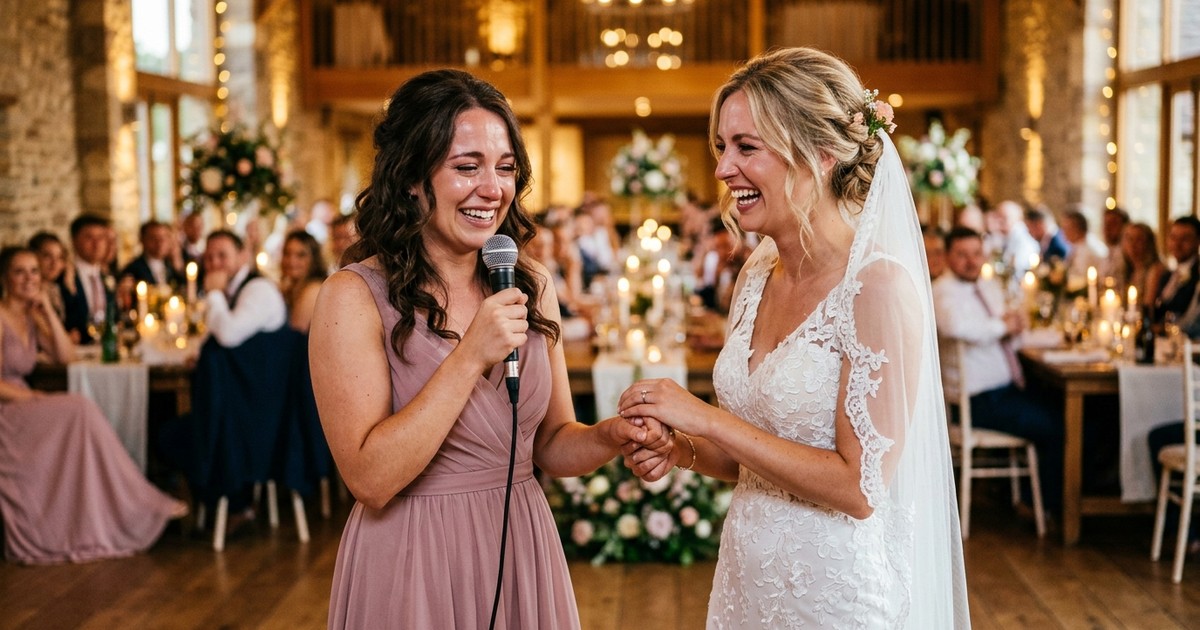
You are going to cry. Accept that now. Do not spend the two weeks before the wedding telling yourself you will hold it together. You will not. Your sister is standing in front of you in a wedding dress, your parents are watching from the front row, and you are about to say out loud the things you normally only think. You are going to cry.
Bring a tissue. Hold it visibly, not hidden in your fist. The audience will root for you harder if they can see you are barely holding it together. A maid of honor fighting back tears during a sister speech is not a failure. It is the most human thing in the room.
Practice the emotional parts out loud until they lose some of their charge. Read the speech to yourself ten times. Read it to a friend. Read it to your dog. The third time you say "I am so proud of who you became" out loud, it will be easier to get through without your voice cracking. The tenth time, you will be able to say it and mean it and still keep going.
If you do cry, do not apologize. Do not say "sorry, I told myself I would not do this." Everyone in the room expected it. Just pause. Breathe. Smile. Let the silence sit for a second. Then keep going. The pause is not a weakness. It is the part of the speech the room will remember most, because it is the moment they saw something real.
One practical note: do not hold your phone or a piece of paper with shaking hands. Print your speech in a large font on card stock. It is easier to read through tears, and it will not shake the way a single sheet of paper will. Small things matter when you are barely keeping it together.
Bottom line
Your sister already knows you love her. She has known it since you were kids. The speech is not about informing her of something she does not know. It is about saying it in a room full of the people who matter most, so they can see, for three minutes, what she means to you.
Pick one story. Make it specific. Say the thing you always mean but rarely say out loud. And then raise your glass.
If you are still staring at a blank page, VowAI can help you get started. It will not write the speech for you, but it will help you find the version of it that sounds like you. And if you want more structure on the full maid of honor speech format, the complete guide covers everything from opening lines to closing toasts.
Related reading: Maid of Honor Speech Guide | Funny Maid of Honor Speech | Maid of Honor Speech Examples