Officiating a Wedding for the First Time: A Friend's Guide
Got asked to officiate? Here is the honest first-timer guide: ordination, talking to the couple, the 5-section ceremony, and how to not panic on the day.
Part of the Wedding Officiant Speech Guide : structure, examples, and what to say when words feel impossible.
It happened over dinner, or on a walk, or in a text that started with "weird question." Two people you love asked you to marry them. Not propose. Marry them, as in stand at the front of the room and run the ceremony. You said yes before your brain caught up, because of course you did. They are family in the way that matters. Then you got home, sat down, and realized you have no idea what officiating a wedding actually involves.
Good news: it is more manageable than it sounds. Friends officiate friends' weddings constantly now, and most of them have no background in this. They figure it out. So will you.
Honest news: it is real work. You are responsible for a legal document, a public ceremony, and the emotional center of someone's day. You can't wing it. But you also don't need a divinity degree. You need a checklist, some honest conversations with the couple, and a few weeks of preparation that you actually do.
This is that guide. If you want the broader overview of the role itself, the wedding officiant speech pillar covers tone, length, and the prep work in more depth.
Step one: get ordained
In most US states, you can become legally ordained online in about ten minutes. Universal Life Church and American Marriage Ministries are the two most common options, both free or close to it. You fill in your name, click a button, and you are a minister.
That part is easy. The part people miss is what your state actually requires after that. Some states accept online ordination without any extra paperwork. A few, including California in some counties, Virginia, Tennessee, and parts of New York, have additional requirements: you may need to register with the county clerk before the ceremony, or file your credentials with a specific office, or appear in person with documentation. Massachusetts has its own one-day designation system. Hawaii has its own license. Each state is its own little maze.
I am not a lawyer and this is not legal advice. The single most important thing you can do is call the county clerk in the county where the wedding is being held and ask, in plain language: "I am an online-ordained minister. What do I need to do to legally officiate a wedding in your county?" They answer this question all the time. They will tell you.
One concrete tip: do this four to six weeks out, not the week of. Some states have waiting periods between when your credentials are filed and when you can perform a ceremony. Some require originals mailed in. The fastest way to ruin a wedding is to discover, three days before, that the state needs something you cannot produce in time.
Step two: talk to the couple
Before you write a word, you need a real conversation with the couple. Coffee, dinner, FaceTime if they live far. Not a text thread. Block out an hour.
Ask three specific things. First, tone: reverent, casual, funny, somewhere in between? A garden ceremony in linen pants is a different ceremony than a cathedral in tails. Second, length: most couples want eight to fifteen minutes of actual ceremony, not counting the processional and recessional. Get a number you can write to. Third, feeling: what do they want guests walking away thinking and feeling? "Held" is a different answer than "delighted." That feeling is your north star.
Then get into the specifics. Ask for permission on every personal story you might tell. Anything you reference about either of them, get it cleared. Surprises during a ceremony are bad surprises. Ask about religious language: do they want it, and if so, which tradition or blend? Some couples want a single line of scripture honoring a grandparent. Others want none. Some want a chuppah, a handfasting, a unity candle, a tea ceremony. Find out what is in and what is out.
Vows are their own conversation. Are they writing their own? Reading after you in call-and-response? Doing a question-and-answer format ("Do you, Sarah, take...")? Different formats need different cues from you. Ask if there is a reading, a ritual, or a moment of silence they want included, and who is doing what. If a friend is reading a poem, you need their name, their relationship to the couple, and the cue you will give them.
By the end of the conversation, you should have enough to write a complete five-section ceremony script template tailored to their day. If you don't, ask more questions. Better now than at the rehearsal.
Step three: write the ceremony
Most ceremonies, religious or not, follow the same five-section shape. You can adjust the proportions to fit the couple, but the bones are usually these.
Welcome (60-90 seconds). You greet the guests, name the gathering, and set the emotional register. This is also where you introduce yourself in a sentence or two. Brief. The room is still settling. If you want a menu of phrases to start from, browse these twelve opening lines and pick one that sounds like you.
About the couple (2-3 minutes). Who they are, how they met, what their relationship looks like from the outside. This is the section where everything good or bad about your ceremony lives. More on this in a second.
Reading or ritual (optional, 2-4 minutes). If the couple wants a reading, a unity ritual, a handfasting, or a moment of silence, this is where it goes. Introduce the reader or ritual cleanly, step back, let it happen, then move on without commentary.
Vows and rings (4-6 minutes). The heart of the legal ceremony. Personal vows, traditional vows, or a hybrid, followed by the ring exchange. Go slow. Short clauses for the repeat-after-me parts. Don't editorialize.
Pronouncement and closing (60-90 seconds). The legal sentence, the kiss, the introduction of the couple to the room. Then you step back and let them walk.
The most common rookie mistake is making the "about the couple" section too long. People come in with eight pages of stories, three running themes, and a poem they wrote. Cut it. Aim for two to three minutes of about-the-couple, not six. The vows are why people came. Don't take their time. If you want to see how the proportions actually play out, look at these six example ceremonies across formal, casual, religious, and secular weddings, and notice how short the personal section actually is.
When it comes to writing the vow language itself, if the couple is writing their own, they don't need your input unless they ask. If they want guidance, point them to a resource like the SpokenVow guide on writing your own wedding vows and let them figure it out together. Your job is the structure around their words, not their words.
Step four: practice out loud (yes, all of it)
Reading something silently and reading it aloud are different activities. The page lies to you. Sentences that look fine on paper trip your tongue. Lines you thought were tender land too long. You don't find out until you say them.
Read the whole ceremony, standing up, out loud, at least three times. Time it. Mark the pauses with slashes in your printed copy. Note where you want to slow down. Note where you want to look up at the couple versus the guests. Underline names and key phrases so your eye finds them fast.
Identify the lines that might make you cry. Practice those specifically until you can get through them without your voice cracking. You will probably still cry on the day. That is fine. But the practice means you have a baseline of control. You are not surprised by your own emotion.
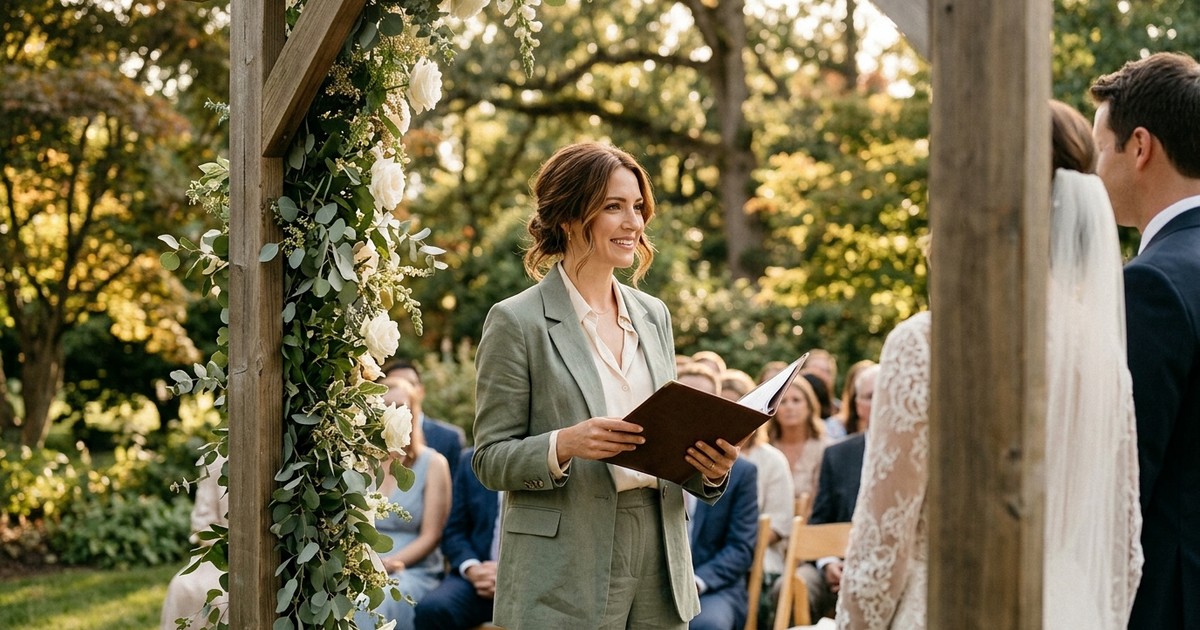
On the day, bring a printed copy on real paper. Not your phone. Phones die, lock, dim, look wrong in photos, and freeze the second you need them. A leather folder or a clean binder looks intentional and works every time. Print one size up from what you'd normally use. You will be reading in bright sunlight or dim chapel light, possibly with watery eyes.
If you lose your place mid-ceremony, just pause and find it. Silence reads as a moment, not a mistake. Nobody in that room is timing you.
Step five: what to do on the wedding day
Get to the venue thirty minutes early, minimum. Find the couple. Reassure them. They are more nervous than you are. A calm officiant is a gift on a wedding morning.
Eat something. Low blood sugar makes everything worse, especially nerves. Bring water and a granola bar in your bag. Skip the open bar before the ceremony. One drink to take the edge off is fine if that is your thing. Two is not.
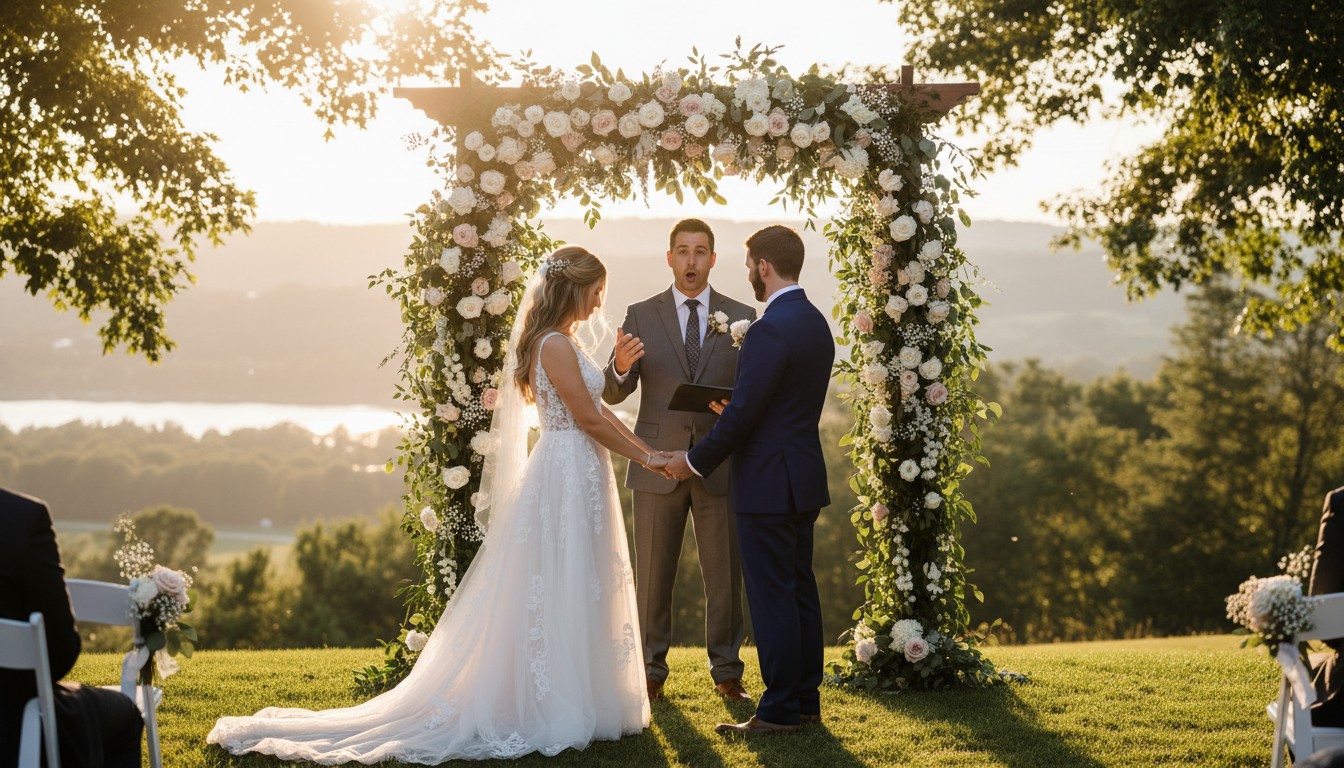
Know where to stand before the ceremony starts. The wedding planner or coordinator will usually mark a spot. If there is no planner, ask the couple where they want you. Generally you stand facing the guests with the couple in front of you, slightly angled so people can see their faces, not the back of their heads. Hold the folder waist-high. Not chest-high, not down by your hip. Steady, visible, easy to read.
During the ceremony, look at the couple when you are speaking about them. Look at the guests when you are speaking to the whole room. Look at the reader when you cue them. It is more intuitive than it sounds once you are in it.
When you get to the pronouncement, slow down. This is the line everyone has been waiting for. Let it land. Then say "you may kiss" with warmth, not as a stage direction. If you get emotional, that is fine. Pause, breathe, keep going. The room will love you for it, not hold it against you.
Five things first-time officiants get wrong
Going too long. The single biggest mistake. Couples and officiants both over-write. Twenty-five minutes feels eternal in folding chairs. Cut what you can. The vows do the heavy lifting. If you are over fifteen minutes, you are taking time that belongs to the couple.
Making it about themselves. "When Daniel and Priya asked me to officiate, I felt so honored..." is a toast, not a ceremony. Two sentences max about your relationship to the couple. Then step out of the way. The room is here for them.
Reading too fast because of nerves. Adrenaline accelerates speech. Write "SLOW DOWN" in red at the top of every page. Practice at half the speed you think is right and you will land at roughly the correct pace.
Forgetting to ask about the kiss. "You may now kiss the bride" is dated. "You may kiss each other," "Daniel, you may kiss your husband," "you may seal these vows with a kiss," and "go ahead, kiss her" are all options, and the couple has a preference. Ask them. Use their words.
Skipping the practice. Reading it through twice in your head the night before is not practice. Standing up, holding the folder, saying it out loud, three full run-throughs, is practice. The difference shows.
A note on getting emotional
You probably will. That is fine. The room wants you to be moved by this. It is a sign that the ceremony is real, that you actually know these people, that what is happening matters to you.
The strategy is not to suppress it. The strategy is to practice the hardest lines until you can say them through tears if you have to. A pause is acceptable. A long pause is acceptable. A sip of water is acceptable. A look up at the ceiling to compose yourself is acceptable. The only thing that isn't acceptable is quitting halfway. If you get to a tough line and you can't get through it, breathe, look at the couple, and try again. Twice if you have to. The room is with you.
You are going to be fine
The couple chose you. Not a stranger. Not a professional. You. They want it to sound like you, with your voice and your humor and your specific way of looking at them. That is the entire point of asking a friend to do this. If they wanted polish, they would have hired polish.
Most first-time officiants do beautifully because they care. The care shows. The preparation shows. The fact that you spent forty hours of your life thinking about how to make their ceremony feel like them, that shows too. The couple will know. The guests will feel it without being able to name it.
Take the work seriously and yourself lightly. Get ordained early. Have the conversation. Write something honest. Practice out loud. Bring the printed copy. Slow down. Then enjoy the front-row seat to one of the best moments of someone's life.
Keep reading:
- Wedding Officiant Speech: A Complete Guide
- Wedding Officiant Speech Examples
- Wedding Officiant Speech Opening Lines
- Wedding Ceremony Script Template
- The Wedding Officiant Speech Blog Guide
- Wedding Vows: How to Write Yours
The couple already chose you. The hard part is over.
Want help writing the ceremony? SpokenVow asks the kind of questions a good speechwriter would, pulling out the real stories about how the couple met, the moment you knew this was the one, the small details only you would mention. Then it shapes them into three ceremony drafts you can pick from.